From fish oil and powders to soft chews and nutritional bites, there are now many different cat skin and coat supplements available. Most combine ingredients such as omega-3 fatty acids, amino acids, vitamins, and plant-derived compounds.
The important question is not simply how many ingredients a supplement contains, but what each ingredient actually contributes to everyday feline nutrition.
What Are Cat Skin and Coat Supplements?
Skin and coat supplements are complementary nutritional products designed to provide selected nutrients alongside a complete diet.
They may contain fatty acids, amino acids, antioxidants, vitamins, or botanical ingredients. Unlike complete food, they are not intended to provide every nutrient a cat needs.
Common Skin and Coat Supplement Ingredients
| Ingredient | Why It Is Used | Best Way to Think About It |
|---|---|---|
| Fish Oil | Provides EPA and DHA omega-3 fatty acids | Skin and coat nutritional support |
| L-Lysine | Essential amino acid | Supplemental amino acid nutrition |
| Quercetin | Plant-derived flavonoid | Complementary botanical ingredient |
| Complete Diet | Provides complete daily nutrition | Foundation of skin and coat health |
Omega-3 Fatty Acids and Feline Skin
Omega-3 fatty acids are among the most common ingredients used in skin and coat supplements for cats.
Marine oils such as salmon oil provide EPA and DHA. Research in cats has examined how dietary fish oils can influence inflammatory and immune responses, including changes in skin response.
This makes omega-3 fatty acids especially relevant to nutritional formulas designed to support normal skin and coat condition.

Where Does L-Lysine Fit?
Lysine is an essential amino acid required in feline nutrition. Complete diets must provide adequate lysine as part of their amino-acid profile.
Additional supplemental lysine is different from the lysine already provided in food. Current research does not support presenting supplemental lysine as a treatment for feline herpesvirus or skin disease.
It is more appropriately viewed as a complementary nutritional ingredient.
What About Quercetin?
Quercetin is a naturally occurring flavonoid found in plants and is commonly used in complementary wellness formulas.
Compared with established feline nutrients such as taurine or omega-3 fatty acids, direct feline clinical research on quercetin remains more limited.
For that reason, it is best described as a plant-derived complementary ingredient rather than as a treatment for feline allergies.
Supplement Support vs. Treatment
| Situation | Nutrition Can Support | What Supplements Do Not Establish |
|---|---|---|
| Everyday coat maintenance | Fatty acids and balanced nutrition | Medical diagnosis |
| Dry-looking coat | Normal skin and coat nutrition | Underlying cause |
| Occasional skin sensitivity | Selected nutritional ingredients | Treatment of disease |
What Makes a Good Cat Skin and Coat Supplement?
- Clearly identified nutritional ingredients
- Transparent feeding directions
- A format your cat will consistently accept
- Ingredients that complement complete food
- Realistic nutritional claims

Powder, Oil or Supplement Bites?
| Format | Convenience | Needs Mixing? | Best For |
|---|---|---|---|
| Liquid Oil | Medium | Usually | Targeted fatty-acid supplementation |
| Powder | Medium | Usually | Cats comfortable with mixed-in supplements |
| Supplement Bites | High | No | Simple repeatable routines |
A Multi-Ingredient Bite Option
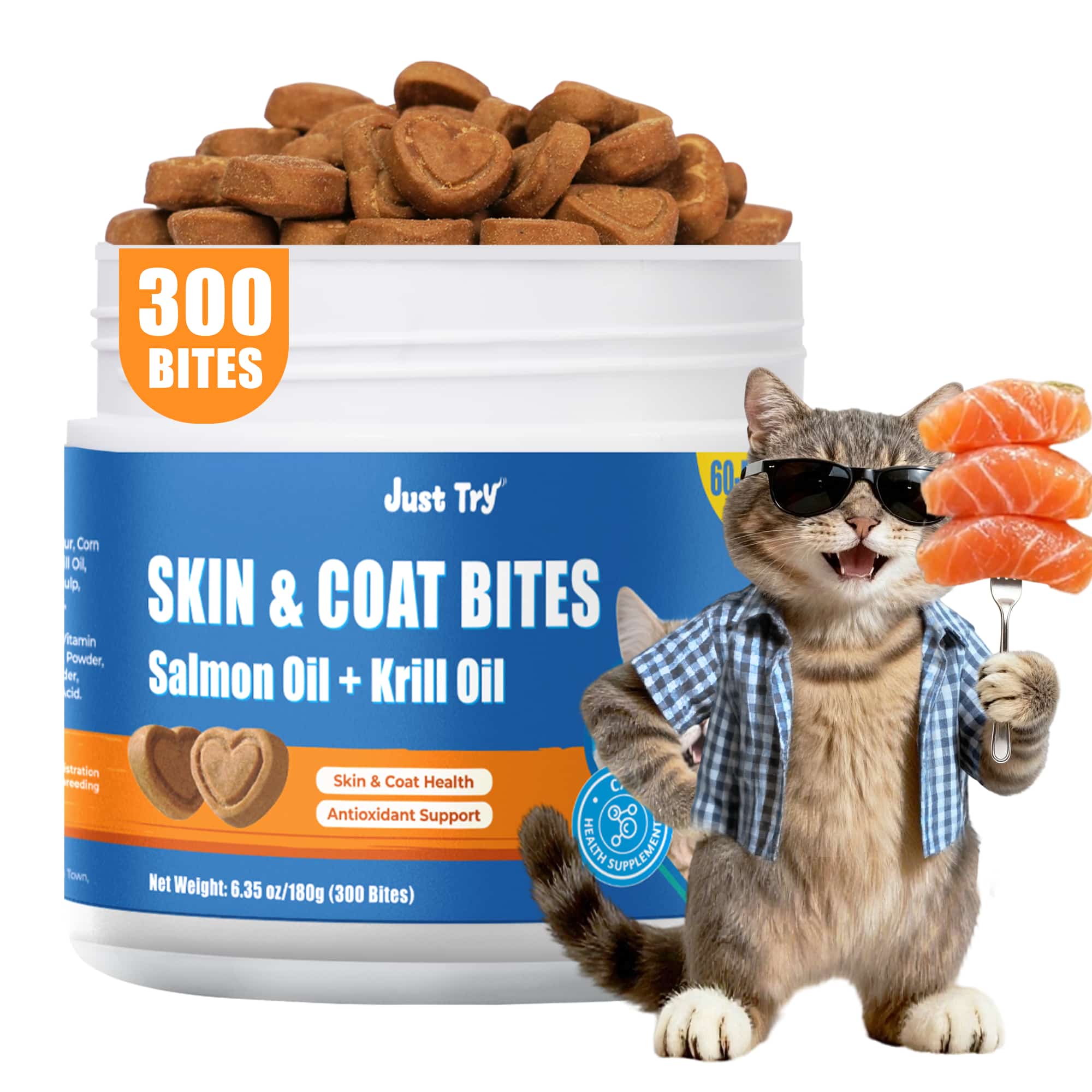
JUSTTRY Allergy & Immune Bites combine L-lysine, salmon oil, and complementary ingredients in a convenient chicken-flavored bite.
This format can be useful for cat parents who prefer one simple bite instead of mixing several separate powders or oils into meals.
FAQ
What supplements are commonly used for a cat's coat?
Fish oil and other sources of omega-3 fatty acids are commonly included in skin and coat formulas.
Is salmon oil useful in cat skin supplements?
Salmon oil provides marine omega-3 fatty acids such as EPA and DHA, which are commonly used for normal skin and coat nutritional support.
Are supplement bites easier than liquid oils?
For some households, yes. Bites do not require measuring or mixing and can be incorporated directly into a daily routine.
Final Thoughts
The best cat skin and coat supplements should be evaluated ingredient by ingredient rather than by the strongest claim printed on a label.
Balanced food remains the foundation, while selected supplements can add targeted nutrients in a convenient format.
Explore JUSTTRY Allergy & Immune Bites.
References
- FEDIAF. Nutritional Guidelines for Complete and Complementary Pet Food for Cats and Dogs. https://europeanpetfood.org/self-regulation/nutritional-guidelines/
- Park HJ, Park JS, Hayek MG, Reinhart GA, Chew BP. Dietary fish oil and flaxseed oil suppress inflammation and immunity in cats. Veterinary Immunology and Immunopathology. https://pubmed.ncbi.nlm.nih.gov/21440312/
- Bol S, Bunnik EM. Lysine supplementation and feline herpesvirus 1: systematic review. BMC Veterinary Research. https://pubmed.ncbi.nlm.nih.gov/26573523/